
Introduction
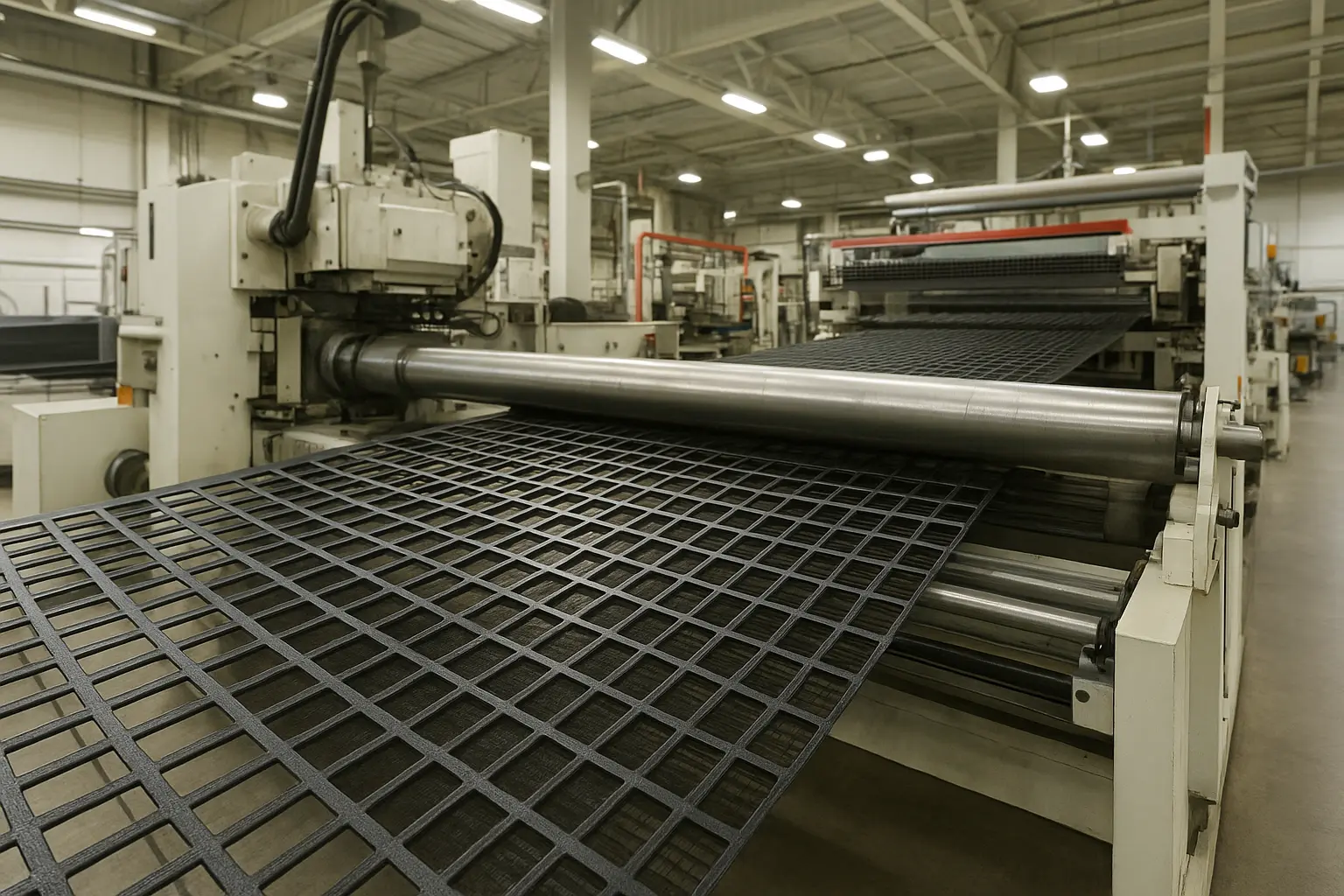
Biaxial geogrids are essential geosynthetic reinforcements used to stabilise soils, improve load distribution, and extend the service life of pavements, embankments and foundations. This article explains the materials and manufacturing steps that turn raw polymer into a high-performance biaxial geogrid.
1. Materials: The Foundation of Geogrid Strength
1.1 Primary Polymers
Prime Terratech uses high-grade polymers such as polypropylene (PP) and polyester (PET) as primary materials. PP offers stiffness and chemical resistance, while PET provides higher tensile strength and better long-term creep performance. For select applications, HDPE may be used where extra toughness is required.
1.2 Additives and Stabilizers
To ensure long service life in harsh conditions, geogrid compounds include UV stabilizers, antioxidants and heat stabilizers. Carbon black is commonly added to black geogrids to enhance UV protection and durability.
2. Manufacturing Process: Precision at Every Step
2.1 Extrusion & Sheet Formation
The process begins with extrusion of the chosen polymer into a calibrated sheet. Uniform sheet thickness is critical for consistent strength across the finished grid.
2.2 Punching: Creating Apertures
A precise punching operation creates a regular pattern of apertures in the extruded sheet. Aperture geometry is designed to optimise soil and aggregate interlock for the target application.
2.3 Biaxial Stretching & Molecular Orientation
Punched sheets are stretched first in the machine direction and then in the cross-machine direction. This biaxial orientation aligns polymer chains, dramatically increasing tensile strength and stiffness in both directions.
2.4 Heat-Setting and Stabilization
After stretching, the grid is heat-set to lock geometry and mechanical properties. This step ensures dimensional stability under load and over time.
2.5 Surface Treatment & Quality Control
Optional surface treatments improve abrasion resistance and bonding with aggregate. Each roll undergoes tensile testing, junction efficiency checks, aperture inspections and visual quality assessments before approval.
3. Key Performance Parameters
The following properties govern real-world performance and are carefully controlled during manufacturing.
| Property | What it Measures | Why it Matters |
|---|---|---|
| Tensile Strength (MD & CMD) | Load capacity in machine and cross directions | Ensures the grid can distribute traffic and structural loads evenly |
| Junction Efficiency | Strength of intersections between ribs | Prevents slippage and ensures load transfer across the grid |
| Aperture Size & Shape | Dimensions of openings | Controls interlock with soil and aggregate for stability |
| Creep Resistance | Dimensional stability under sustained load | Determines long-term performance and settlement behaviour |
| Durability | Resistance to UV, chemicals and biological attack | Ensures long in-service life in exposed environments |
4. Matching Material & Manufacturing to Applications
Different projects require different material and manufacturing choices. High-traffic highways demand geogrids with high tensile modulus and excellent durability. Soft soil embankments benefit from flexible grids with strong interlock. Prime Terratech manufactures product variants to meet these varying demands.
- Roads & highways: high tensile strength and long life
- Railway beds: low deformation and strong aggregate interlock
- Embankments: flexibility and corrosion resistance
- Industrial yards & foundations: increased bearing capacity and reduced settlement
5. Innovations & Sustainability
Prime Terratech continuously invests in R&D to improve polymer blends, refine punching and stretching precision, and adopt energy-efficient manufacturing. We also explore recyclable formulations and process efficiencies to reduce environmental impact while maintaining performance.
6. From Factory to Field: Quality You Can Trust
Our quality assurance system includes multi-stage inspections, tensile testing, and full traceability of each roll. Technical support from product selection to installation ensures that material performance in the field matches the engineered expectations.
Conclusion
The reliability of a biaxial geogrid is determined long before installation — in the choice of polymer, formulation of additives, and the precision of the manufacturing process. By controlling these variables, Prime Terratech Industries Pvt. Ltd. delivers geogrids that perform reliably across demanding civil and geotechnical applications.